QR Codes vs NFC for Customer Engagement: When SMBs Should Use Each
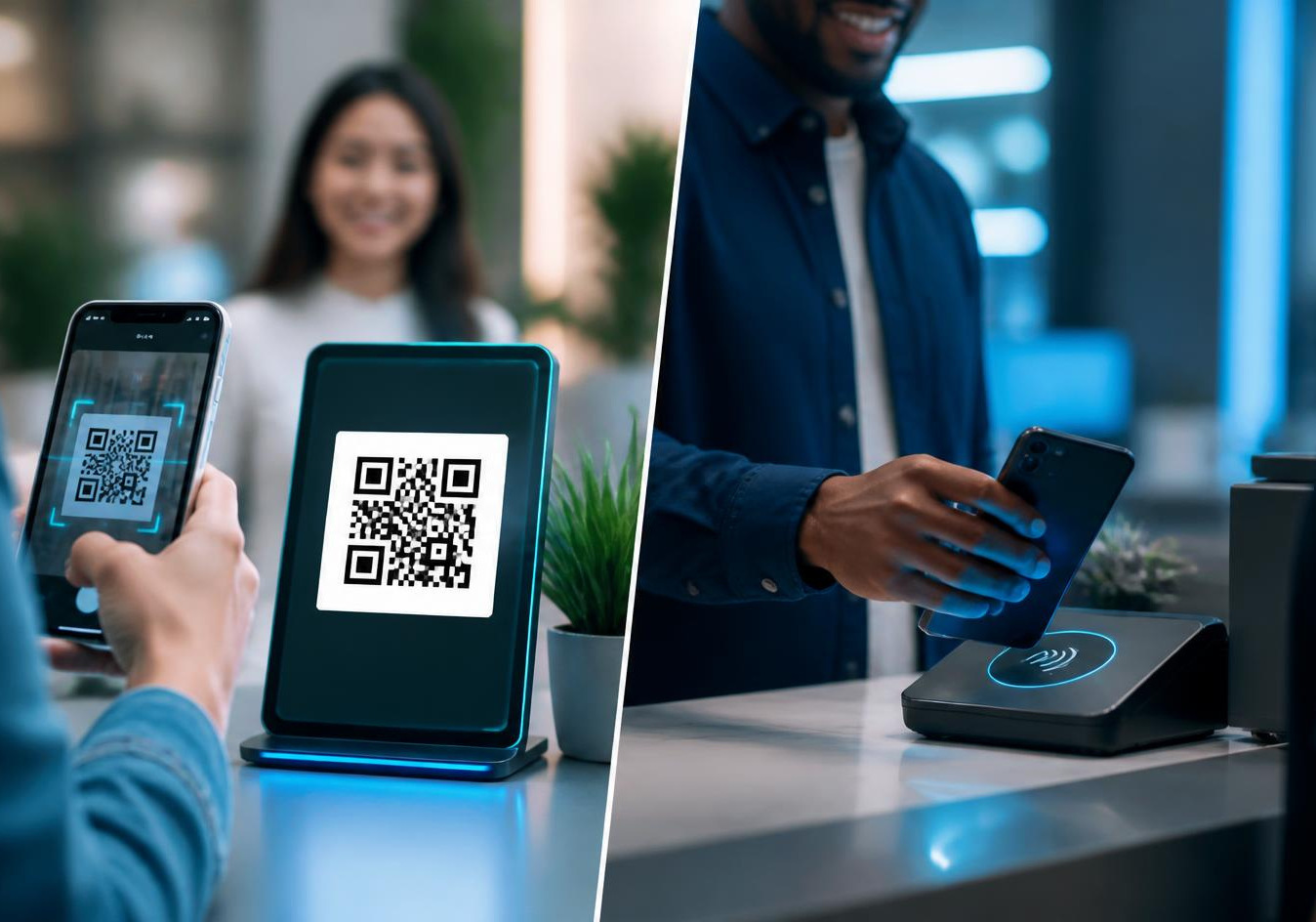
Walk into any restaurant, dental office, or gym today, and you're likely to see one of two things: a small black-and-white square requesting a scan or a small tap area near the register requesting a phone. QR codes and NFC tags anchor the entire small and mid-sized business digital customer journey—menus, loyalty sign ups, check-ins, reviews, and payments all begin with either a QR scan or an NFC tap.
Adoption has passed the experimental phase and is now growing at a rapid pace. Over 102 million people in the US are predicted to scan a QR code in 2026, about one in three Americans (eMarketer/Insider Intelligence), and marketers have embraced the channel at scale, with 98% reporting QR codes had a positive impact on their marketing over the past year (eMarketer). NFC is rising on a similar trajectory—the global NFC market was valued near USD 25-30 billion in 2024 and is on pace to roughly double by the early 2030s as contactless payments and tap-to-engage retail experiences become standard (Global Market Insights; MarketsandMarkets).
The question facing any restaurant, dental office, gym, gas station, or laundromat is not so much "QR or NFC?" but rather which technology fits which moment, and how to track what happened after the user engaged with the code or tag. This guide covers those differences.
What Is a QR Code, and What Is It Best At?
A QR (quick response) code is a printable, scannable image that can be read by a smartphone camera. QR codes require no special hardware beyond a smartphone camera (which any customer is likely to carry), making them the absolute cheapest option for linking a physical location to a digital destination.
Where QR codes tend to shine for small and mid-sized businesses:
- Restaurant and quick-service restaurant (QSR) menus, printed on tables and counters
- Dental and medical intake forms, printed at check-in
- Gym class schedules and waiver forms
- Gas station pump-topper promotions
- Laundromat machine instructions and payment links
- Front-desk or office check-in flows
Strengths:
- Low cost to produce and update
- No special hardware requirements on the part of the customer
- Easy to place on temporary signage, table tents, receipts, or packaging
- Easy to track with UTM parameters and redirect links
Trade-offs:
- Requires a working camera and adequate lighting
- Can be crowded on signage
- Slightly more friction than a tap, as the customer must open the camera app and scan
On the other hand, some retailers argue QR codes feel old compared to a one-tap NFC experience. But for most small and mid-sized businesses, cost and universal accessibility outweigh that consideration.
What Is NFC, and What Is It Best At?
NFC (near field communication) enables a phone to exchange data with a chip simply by tapping it. NFC does not require a camera, or an application, and sometimes not even an unlocked phone. NFC is the same technology that enables Apple Pay and Google Pay taps at the checkout counter, and is increasingly being embedded into table tents and equipment.
Where NFC tends to shine for small and mid-sized businesses:
- Restaurant tables ("Tap for today's specials")
- Dental office kiosks ("Tap to check in")
- Gym equipment ("Tap for a how-to video")
- Laundromat machines ("Tap to pay or start a cycle")
- Gas pumps ("Tap to join our loyalty program")
Strengths:
- Faster, more seamless interaction
- No visible printed code, which keeps signage and fixtures looking cleaner
- Suited to permanent installations, like embedding a chip in a table or piece of equipment
- Increasingly associated with premium, modern brand experiences
Trade-offs:
- Higher upfront hardware cost per tag or fixture
- Requires an NFC-enabled phone (most modern smartphones qualify, but not all)
- Slightly more complex to deploy and replace than a printed code
QR Codes vs. NFC: A Side-by-Side Comparison
How to Measure What's Actually Working
A scan or a tap are only valuable to the extent a business can measure what happened next. Which is why businesses using QR codes or NFC tags tend to lose the thread: they put a code on a table but have no way to measure which location, table, or campaign is driving the most engagement.
For QR codes, a typical approach is:
- Generate a unique short link or UTM-tagged URL for each placement (table, location, or campaign)
- Route the link through a redirect service so the destination can be updated without reprinting the code
- Track scans, click-through, and downstream conversions (sign-ups, orders, redemptions) in an analytics dashboard
For NFC, a similar approach would be:
- Assign a unique URL to each physical tag, even if they all point to the same landing page
- Log tap events by tag ID so each fixture or location can be measured on its own
- Compare tap-through and conversion rates to QR performance for the same offer
Xathari's Customer Engagement Platform generates and manages both QR and NFC touchpoints from one dashboard, so a multi-location business can see scan and tap activity per store, table, or campaign, without stitching together separate tools.
Choosing Your Level of Insight: Tiered Analytics
Not every business needs the same depth of data on day one, and Xathari's Customer Engagement Platform is built around three tiers so a business can start simple and add depth as it grows:
Basic (Tier 1) — Core Tracking. Instant visibility with zero setup. Every QR/NFC interaction is tracked by unique scans, device type, location (city, region, country), and timestamp and engagement patterns. This tier suits businesses that want clean, reliable tracking without touching analytics tools.
Advanced (Tier 2) — Demographic Enrichment. Everything in Basic, plus audience insight powered by Google Signals — age ranges, gender distribution, interest categories, and device and behavior patterns — without modifying the landing page a scan or tap leads to. This tier suits brands that want to understand who's scanning, not just how many.
Premium (Tier 3) — Full-Funnel Intelligence. Everything in Advanced, plus full behavioral analytics: post-scan page interactions, conversion tracking, funnel analysis, retargeting audiences, and multi-step journey insights. This tier follows a customer from scan to engagement to conversion, and suits performance marketers and enterprise teams that need to prove ROI down to the individual touchpoint.
A restaurant testing its first table-tap menu might start on Basic just to confirm which tables get the most traffic. A multi-location gym chain running loyalty promotions across QR and NFC might move to Advanced to see whether a campaign is landing with the age group it was built for. A business running paid local advertising alongside CEP — to make use of the six-month free CEP access that comes with a qualifying Local Advertising campaign — will typically want Premium, since that's the tier that connects an ad impression all the way through to a tracked conversion.
What a Scan or Tap Can Launch
QR and NFC aren't limited to sending a customer to a plain web page. Every scan or tap can launch a purpose-built experience, including:
- Augmented reality (WebAR) experiences
- Product manuals and how-to guides
- Promotional offers and coupons
- Loyalty rewards
- Menu boards and service information
- Event check-ins
- Interactive product showcases
- AI-enhanced animated pages
A gym, for example, can use an NFC tap on a piece of equipment to launch a short WebAR demonstration instead of a static instruction sheet. A dental office can use a QR code at check-in to launch an interactive intake form rather than a paper clipboard. A restaurant can pair a table-tap with an animated specials page instead of a plain menu link. Businesses that want to build these themselves can do so directly in Xathari's dashboard; those who'd rather not can use Xathari's Managed Services for page creation — static, animated, AI-enhanced, or WebAR — along with campaign setup and analytics configuration.
The Hybrid Approach: Why Most SMBs Should Use Both
Thinking in terms of an either/or decision misses an opportunity. QR codes are great for coverage: cheap enough to put on receipts and window clings, and flexible enough to update as needed. NFC is great for premium touches: a table or equipment tap that has a frictionless feel. A restaurant might print a QR code on the receipt for a review request (low cost, high volume) and embed an NFC tag in the table for the "tap for today's specials" experience (higher-touch, repeat customer engagement). A gym might use QR codes on the class-schedule poster but NFC tags on individual machines for instructional content. Layering both gives a business a more complete surface area to capture customer intent, and gives Xathari's analytics dashboard a more complete picture of which channel drives which outcome.
A Simple Decision Framework
Choose QR codes when:
- Budget is tight or the rollout needs to happen fast
- The placement is temporary (a seasonal promo, a one-off event)
- Reach and visibility matter more than a premium feel
Choose NFC when:
- The installation is permanent (a table, a piece of equipment, a kiosk)
- Brand experience and a frictionless interaction matter
- The business can absorb a modestly higher hardware cost per touchpoint
Use both when:
- The business wants maximum coverage across different customer moments
- Full, per-touchpoint attribution matters for measuring ROI
- The business operates across multiple locations and needs to compare performance location by location
Frequently Asked Questions
Do customers need an app to use QR codes or NFC?No. Modern smartphone cameras read QR codes natively, and most phones from the last several years support NFC taps without any app installed.
Which is cheaper to deploy across many locations?QR codes are almost always cheaper up front since they're just printed graphics. NFC tags cost more per unit but can last longer in permanent installations and reduce wear-and-tear issues associated with printed signage.
Can QR codes and NFC be tracked in the same dashboard?Yes. A platform built for both, like Xathari's Customer Engagement Platform, unifies scan and tap data so a business doesn't have to check two separate systems to see what's working.
Is NFC actually more secure than QR codes?NFC's short range (typically under a few centimeters) makes it harder to intercept than a QR code, which anyone within camera range can photograph. Neither technology is inherently unsafe for typical marketing use cases, but businesses handling payments should follow their processor's security guidance either way.
How often should a business update its QR or NFC content?Content tied to time-sensitive promotions should be refreshed at least monthly. Because both QR redirects and NFC tag destinations can usually be updated without replacing the physical code or chip, the underlying hardware rarely needs to change—just the destination.
What's the difference between Xathari's analytics tiers?Basic tracks core scan and tap data (device, location, timestamp) with zero setup. Advanced adds demographic enrichment—age, gender, and interest categories—powered by Google Signals. Premium adds full-funnel tracking, following a customer from scan through engagement to conversion, which is the tier most performance marketers and enterprise teams need.
Key Takeaways
- QR codes win on cost, reach, and flexibility; NFC wins on speed and premium feel.
- Most small and mid-sized businesses get the best results from a hybrid deployment rather than picking one exclusively.
- Attribution—knowing which table, location, or campaign drove a scan or tap—matters more than the technology choice itself.
- A scan or tap can launch far more than a web page—WebAR, loyalty rewards, interactive product showcases, and animated pages are all fair game.
- Xathari's three analytics tiers (Basic, Advanced, Premium) let a business start with simple tracking and add audience and funnel data as its needs grow.
- A single dashboard that tracks both channels makes it far easier to compare performance and double down on what's converting.
Whether a business is just adding its first QR code to a menu or planning NFC-enabled tables across a five-location chain, the same principle holds: the technology is only as useful as the data it produces. Xathari's Customer Engagement Platform is built to generate QR and NFC touchpoints, track every scan and tap, and connect that activity to the signage and local advertising a business is already running—giving multi-location small and mid-sized businesses one place to see what's actually driving engagement.